
Do you ENJOY language?
A question by one of my most beloved actors (and voices), Stephen Fry:
Do you?
The illustrated guide to a Ph.D.
Imagine a circle that contains all of human knowledge:

By the time you finish elementary school, you know a little:

By the time you finish high school, you know a bit more:

With a bachelor’s degree, you gain a specialty:

A master’s degree deepens that specialty:

Reading research papers takes you to the edge of human knowledge:

Once you’re at the boundary, you focus:

You push at the boundary for a few years:

Until one day, the boundary gives way:

And, that dent you’ve made is called a Ph.D.:

Of course, the world looks different to you now:

So, don’t forget the bigger picture:

Keep pushing.
I challenge you: just finish it

I know that most of the times I am just like a mathematician who loses interest in the problem once they find there is a solution.
I cannot focus my attention on a single thing.
In my head a new idea is always impeccable and I am surefooted and adequate to doing it. I imagine the end result, the rapture, the joy, and… my interest evaporates.
-
Doable = No challenge.
-
No challenge = No interest = Not for me (I have a new idea!)
Same with reading. In the past four years there were just two periods when I have been reading just one book at a time: the Harry Potter and later the Hunger series. My other books in the queue are just equally interesting, so I alternate between all of them. 30 pages of this one, 20% of the other. The books are now over 200 (two hundred). Yep. This is an issue.
- Starting isn’t Useful Without Finishing
Starting interesting things is a worthwhile trait, but perhaps a more important one is finishing those things. The world is full of half-finished projects which could have been great if the fire-starter hadn’t burnt out a month or two in.
The courage to start things needs to be matched with the discipline to see them through. They’re both critical, and my guess is that you can probably assess which one you need to work on.
http://www.scotthyoung.com/blog/2012/02/19/just-finish-it/
What is it with my finished projects?
The unexpected happens.
My sewing: I start with an idea (and a pattern) and end up with a completely different outcome. Get-go with a skirt pattern, end up with a dress. (too much imagination)
My blogging: You can bet that what you are reading now are not the perfect ideas, dressed in pluperfect words, dancing in excellent grammar lines that I had in my mind 30 minutes ago… (this is nothing like it)
And I do not like the unexpected. Nope, no surprises for my liking.
Ahem…decide!
The first small step.
I made my decision to finish the 240 book lot before thinking about buying or borrowing new one.
Three days in the venture, I already have finished 3 books, and today will be the fourth and the fifth.
To You
So, as much as I challenge myself, I challenge you: just finish it.
Whether it is a book you read/write, a project, or a simple task, don’t always strive for perfection at any cost (paralysing you from doing a thing), reach for the end line. Finish. Then go back, polish, edit, revise, re-write, re-do, but first have it complete. You will clear you mind for the new ideas instead of rethinking the pending ones. “Truth will sooner come out from error than from confusion.” ~Francis Bacon
Just do it. Finish
(and then tell me how you did it, I still learn),
P.S. 11 hours later my finish-two-books-today mission is complete. How about your progress? I am eager to know (but also can wait). 🙂
The the impotence of proofreading
Here’s another performance of Taylor Mali, this time on the importance of proofreading your works.
A good laugh and yet some food for thought 🙂
Has this ever happened to you?
You work very horde on a paper for English clash
And then get a very glow raid (like a D or even a D=)
and all because you are the word1s liverwurst spoiler.
Proofreading your peppers is a matter of the the utmost impotence.
This is a problem that affects manly, manly students.
I myself was such a bed spiller once upon a term
that my English teacher in my sophomoric year,
Mrs. Myth, said I would never get into a good colleague.
And that1s all I wanted, just to get into a good colleague.
Not just anal community colleague,
because I wouldn1t be happy at anal community colleague.
I needed a place that would offer me intellectual simulation,
I really need to be challenged, challenged dentally.
I know this makes me sound like a stereo,
but I really wanted to go to an ivory legal collegue.
So I needed to improvement
or gone would be my dream of going to Harvard, Jail, or Prison
(in Prison, New Jersey).
So I got myself a spell checker
and figured I was on Sleazy Street.
But there are several missed aches
that a spell chukker can1t can1t catch catch.
For instant, if you accidentally leave a word
your spell exchequer won1t put it in you.
And God for billing purposes only
you should have serial problems with Tori Spelling
your spell Chekhov might replace a word
with one you had absolutely no detention of using.
Because what do you want it to douch?
It only does what you tell it to douche.
You1re the one with your hand on the mouth going clit, clit, clit.
It just goes to show you how embargo
one careless clit of the mouth can be.
Which reminds me of this one time during my Junior Mint.
The teacher read my entire paper on A Sale of Two Titties
out loud to all of my assmates.
I1m not joking, I1m totally cereal.
It was the most humidifying experience of my life,
being laughed at pubically.
So do yourself a flavor and follow these two Pisces of advice:
One: There is no prostitute for careful editing.
And three: When it comes to proofreading,
the red penis your friend.
Cincirily,
How to write for the European Institutions

Are you an aspiring non-fiction author, or translator, maybe? Dreaming for a career in the European Parliament and/or Commission?
There you have two useful tools that will help you achieve the EU- English (house) style:

Writing in clear language can be difficult at the Commission, since much of the subject matter is complex and more and more is written in English by (and for) non-native speakers, or by native speakers who are beginning to lose touch with their language after years of working in a multilingual environment. We must nevertheless try to set an example by using language that is as clear, simple, and accessible as possible, out of courtesy to our readers and consideration for the image of the Commission.
-
How to write clearly
(16 pages, PDF)

- Think before you write
- Focus on the reader — be direct and interesting
- Get your document into shape
- KISS: Keep It Short and Simple
- Make sense — structure your sentences
- Cut out excess nouns – verb forms are livelier
- Be concrete, not abstract
- Prefer active verbs to passive — and name the agent
- Beware of false friends, jargon and abbreviations
- Revise and check
- Online EU drafting aids
Yours europeanly,
A “Siri” conversation: What can I help you with?

My faithful Personal Assistant, Mr. Siri.
He is British and although we had some initial issues with our accents (my pronunciation of “Maria” is “Midea” to him), we are mates now 🙂
With some inspiration from: http://siri-jokes.com/, there we had a nice conversation (mhm, yep, the window was open. Now my neighbours assume I have a bit slow Englishman at home (not that far from the truth)):
Ok, ok, I’ll get some sleep (for I most certainly need it),
Quote of the day
Never forget what you are, for surely the world will not. Make it your strength. Then it can never be your weakness. Armor yourself in it, and it will never be used to hurt you.
Tyrion Lannister – Game of Thrones

Idiom: Chip on your shoulder

Fig. a bad attitude that tends to get someone easily upset.“Why did you get so angry at the slightest criticism? You seem to have a chip on your shoulder.”
Meaning
A perceived grievance or sense of inferiority.
Origin
The word chip has several meanings; the one that we are concerned with here is the earliest known of these, namely ‘a small piece of wood, as might be chopped, or chipped, from a larger block’. The phrase ‘a chip on one’s shoulder’ is reported as originating with the nineteenth century U.S. practice of spoiling for a fight by carrying a chip of wood on one’s shoulder, daring others to knock it off. This suggested derivation has more than the whiff of folk-etymology about it. Anyone who might be inclined to doubt that origin can take heart from an alternative theory.
It should probably look like:

AND it does not imply a real chip or a piece of chips, mind you 🙂

NOR

NOT, not even that chip. Certainly not.

They said what?!
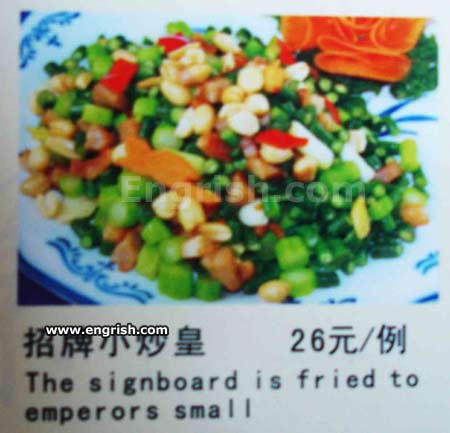
Engrish it is:
n. The phenomenon of often hilarious gramatical catastrophes resulting from poor, usually over-literal translations of Japanese to English.
A form of English characterized by bad translation from Japanese by someone who is decent at translating vocabulary but has a poor grasp of English grammar. Tends to be a word-by-word literal translation with humorous results for native English speakers. Engrish is most common in old video games and anime subtitles.
The term “Engrish” comes from the fact that the Japanese language does not have distinct L and R sounds. They do have a consonant that is roughly somewhere in between these two sounds, but whether this translates to L or R in English depends on the situation (and therefore can be interpreted wrong.)
So, there they go:












In mood for some more Engrish?
Must go now I to ,
Quote of the day

So avoid using the word ‘very’ because it’s lazy. A man is not very tired, he is exhausted. Don’t use very sad, use morose. Language was invented for one reason, boys – to woo women – and, in that endeavor, laziness will not do. It also won’t do in your essays.— John Keating, Dead Poet’s Society


AWARDS









 Just English