
That that is is that that is not is not is that it it is

That that is is that that is not is not is that it it is is an English word sequence demonstrating syntactic ambiguity. It is used as an example illustrating the importance of proper punctuation.
The sequence can be understood as either of two sequences, each with four discrete sentences, by adding punctuation:
That that is, is. That that is not, is not. Is that it? It is.
8 Overused Cliches Employers Are Sick Of Seeing in Resumes
Written
Looking for a new job isn’t easy, and it can be hard to want to put your best into every iteration of your resume and cover letter. But here’s the thing: even though the economy’s been improving, times are still tough. Plenty of people are looking, and that means for every job opening you see, there’s some HR person out there who is being swamped with a deluge of resumes.
If you want to be sure your resume will actually make them hit the pause button (figuratively) and not the delete button (literally), you’ve got to avoid these cliche words and phrases that sound impressive but don’t actually convey much meaning.

“I’m a creative thinker”
Unless it’s literally part of your job title (e.g., Creative Director), “creative” is an adjective that’s become so overused it’s utterly meaningless to many recruiters. Think of what the inverse of this statement would be: “I only think inside the box.” “I can’t come up with anything new.” “I have no ideas of my own to contribute.” Literally no one is going to say that, so it means that stating the obvious is well, pretty obvious.
Instead of saying you’re creative, demonstrate that you’re creative with a well-written cover letter. Give a specific example of a problem you’ve overcome, a solution you devised, or how you’ve managed to expand your current role.

“I’m results-oriented.”
Again, who exactly doesn’t want to get results for their employer? (A person they don’t want to hire, that’s who!) They will assume you’re results oriented, so show them the actual results.
Numbers can help here: Quantify how many sales you made in the last quarter, the number of people you’ve supervised as part of your team, or the amount of traffic your ad campaign drove to your client.
 “I’m a guru/ninja/expert/etc.”

No, no, no. Unless “Guru” or “Ninja” is your actual job title, skip the enthusiastic euphemisms. Yeah, if one of your references describes you that way, it’s great — but if you’re talking about yourself like this, it’s a bit empty.
If you really are extra-super-good at what you do, show it by listing your accomplishments: Grants you won, conferences you’ve spoken at, programming languages or software you’ve mastered, and so on. If you’re kicking butt, your accomplishments will convey that for you.

“I have excellent oral and written communication skills.”
Another case of something you should show, not tell. Though you’ll frequently see this on job descriptions, if it shows up in your cover letter or resume it feels like filler — because it is. If you really do have excellent communication skills, you’ll have a cover letter that’s clearly written, appropriately tailored to the position, and inviting to the reader. Same goes for your resume.
Drop this line, and spend the extra time proofreading to make sure that you don’t have any spelling errors or grammar gaffes. (If you’ve read your own resume so many times that you won’t even notice a mistake, ask a friend to proof it for you.)

“My references are available upon request.”
Well, yeah, they should be! Even if a potential employer hasn’t asked for your references yet (and many don’t until you’re doing a formal application), it’s more than acceptable to let them assume that of course you have references.
If they have asked for you references, name them and give their contact info in the appropriate part of the form, in a separate document, or below your cover letter, if you’re sending that in the body of an email. (In those instances, say something like, “Attached please find my references” or “Please find my references listed below.”) If they didn’t ask? Just don’t mention it for now. Use the extra space to say something useful about yourself!

“I’m detail-oriented.”
No one’s going to say “I’m a total space cadet” or “I don’t sweat the small stuff.” But saying you’re detail-oriented has become such a cliche as to be totally meaningless (not least because so many recruiters see resumes that are riddled with spelling errors and cover letters personalized for the wrong company by applicants who claim to be “detail-oriented”). Again, show this by making sure that your cover letter and resume are free of basic grammar and spelling slip-ups.
You can also demonstrate your attention to detail by being specific in your discussion of what you do: Managed a staff of three interns; Served as liaison between lab group and department head; Spearheaded development of pay-per-click marketing campaigns for X, Y, and Z clients.

“Duties:”
Don’t just list! Your resume needs to tell a story about you, not just rehash the job posting for your previous gig. Instead of making a simple list that begins with “duties” or “responsibilities include” (come on, you know that sounds like a total snoozefest), use active verbs to help convey the specific tasks you’ve accomplished on the job. Collaborated with internal team and external vendors to source products, implemented a new system for tracking leads, revamped corporate website to reflect new brand strategy.
Even if what you do isn’t terribly thrilling, using specific, active verbs can your resume stand out. (E.g., “Client communication” versus “Communicated with clients to ensure that targets were met and issues were promptly resolved.”)

“I’m passionate about what I do.”
Are you? Though today many employers want an intense level of commitment (which is a whole other deal), there are limits to how “passionate” one can be about, say, a call center job. Likewise, if you’re just starting out and you’re applying for jobs that are in a wide range of fields, you probably don’t have a “passion” for each and every one of them. If you actually are into what you do, it should be conveyed not only by your cover letter and resume, but also by your web presence (and yes, you should assume that before you get an interview request, you’re going to be Googled).
Your LinkedIn profile should obviously show that you’re excited about what you do, but ideally any other public profile (e.g., Twitter, which relatively few people have set to private) should reflect your interest and enthusiasm, at least a little. If it doesn’t, just leave “passionate” out of it. Otherwise, you’re just setting yourself up for an interview fail: “So, what makes you passionate about being an administrative assistant?” “Uhhhhhhhhh.” Don’t lay out anything in your cover letter or resume that you aren’t ready to answer for when you finally get that call.
Source
Image source: pixabay.com
Seven Tips for Communicating Data

Written by Lynn Gaertner-Johnston, Syntax Training
After you have worked hard to collect meaningful data, the big challenges are how and how much to communicate. Consider these tips when you work on your next report or presentation that includes data.
- Focus first on your message, not on the numbers.
When planning your communication, focus first on the big idea or points you want to make. Then incorporate the data that will help your audience understand and appreciate your points. Be sure your big idea gets center stage, not the numbers. - Explain the data.
Numbers mean nothing on their own. They need interpretation. Avoid asking readers or your audience to “review the attached spreadsheets.” Why should they review them? Which numbers should they pay attention to and why? What do the numbers indicate? - Put data in context.
Make it clear whether numbers are positive, negative, or neutral. If you tell a sales rep that she visited an average of six prospects per day, compare that number to the goal number of prospects. If a client walks 5500 steps in a day, state whether 5500 is the magic healthy number or only halfway there. If expenses are 18 percent over income, say why the reader should care. Explain that the account balance will be €0 by 2018 if nothing changes. - Paint a picture with your numbers so people can see them.
Even simple expressions like “a tenfold increase” or “a 30 percent drop” can seem vague unless your audience can see them. If numbers have decreased dramatically over a decade, do not use words and numbers alone. In a bold-colored graph, show the deep drop year by year, month by month over 10 years.

If your numbers are so large as to be abstract, paint them in recognizable mental pictures such as an area as large as Italy or a distance of 100 Greyhound buses. (Think of your audience when you choose the image.) How hot is 158 degrees Fahrenheit? Hot enough to fry an egg on the sidewalk.
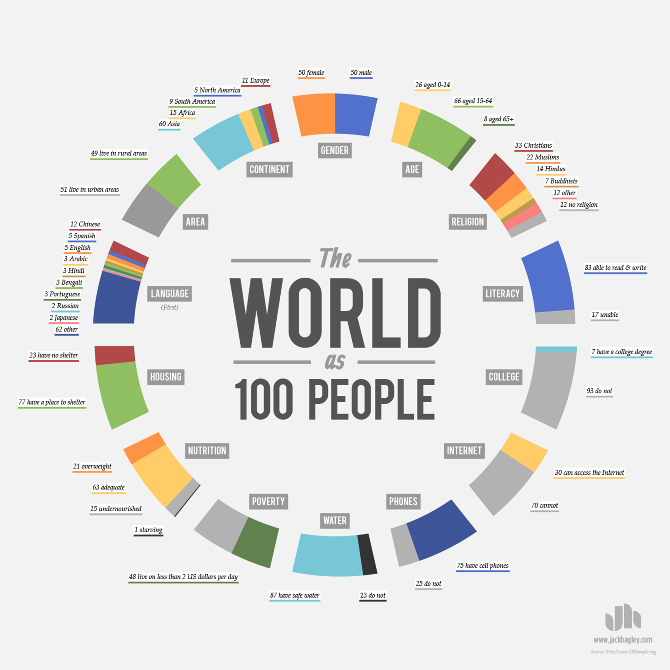
Or show the numbers reduced to their essence. Jack Hagley’s graphic “The World as 100 People” (www.jackhagley.com/The-World-as-100-People) presents the world as though it were only 100 people. For instance, 83 of the world’s 100 people are able to read and write; 17 are not.
- Highlight important numbers.
A wall of numbers is as intimidating as a wall of text. Pull out essential numbers and focus on them. If you are presenting financial data, show just a small portion of it at a time on a slide or a page–just the portion you are discussing now. If you refer to and show just a small part, your audience will not say, “Where are you?” and “What are you talking about?” And always render numbers in a large enough font that you do not have to apologize for it.
Make it easy for your readers to find important numbers. If a client has asked for your fee, for example, don’t bury the number in a paragraph. Instead, render the number alone on a line or as part of a short heading, like this:
Your investment: US$19,000
- Prominently display the legends for tables and charts of numbers.
Ensure that your audience will know instantly that 3000 indicates 3,000,000 and that your balance is positive rather than negative. Use abbreviations such as K and M only if you are certain your readers understand them. (To some people, M means thousand; to others, it means million.) - Use only the essential, compelling numbers in the body of your document.
If numbers weigh down your document, your readers may forget your main point. So move most of the supporting tables, lists, charts, and graphs to the appendices. In a presentation, hold back some slides of data, and show them only upon request. Remember: The numbers are not the message; they serve the message.
If you think of your communication as music, your most important message comes through the soloist. The numbers are the accompanists. They play an essential role, but they should never drown out the soloist. If they do, your communication will not reach and change your audience.





100+ Video Sites Every Educator Should Bookmark
By: Alvina Lopez
Bringing multimedia into the classroom is a great way to engage students in learning. Supplementing lessons, opening up new interests, and offering inspiration, online videos make for an incredible teaching tool.
Educational Video Collections

Specifically designed for education, these collections make it easy to find video learning resources.
- TeacherTube: This YouTube for teachers is an amazing resource for finding educationally-focused videos to share with your classroom. You can find videos uploaded by other teachers or share your own.
- Edutopia: An awesome place to find learning ideas and resources, Edutopia has videos, blogs, and more, all sorted into grade levels.
- YouTube EDU: A YouTube channel just for education, you can find primary and secondary education, university-level videos, and even lifelong learning.
- Classroom Clips: Classroom Clips offers media for educators and students alike, including video and audio in a browseable format.
- neoK12: Find science videos and more for school kids in K-12 on neoK12.
- OV Guide: Find education videos on this site, featuring author readings and instructional videos.
- CosmoLearning: This free educational website has videos in 36 different academic subjects.
- Google Educational Videos: Cool Cat Teacher offers this excellent tutorial for finding the best of Google’s educational videos.
- Brightstorm: On Brightstorm, students can find homework help in math and science, even test prep, too.
- Explore.org: Explore.org shares live animal cams, films, educational channels, and more for your classroom to explore.
- UWTV: Offered by the University of Washington in Seattle, UWTV has videos in the arts, K-12, social sciences, health, and more.
- Videolectures.net: With Videolectures.net, you’ll get access to browseable lectures designed for the exchange of ideas and knowledge, offering videos in architecture, business, technology, and many more categories.
- TED-Ed: From a site that’s long been known for big ideas, you’ll find TED-Ed, videos specifically designed to act as highly engaging and fun lessons.
- Zane Education: Zane Education offers resources for visual learning, including the very popular on demand subtitled videos.
- Backpack TV: In this educational video library, you’ll find a special interest in math, science, and other academic subjects.
- MentorMob: Featuring learning playlists, MentorMob is a great place to find lessons you want to teach.
- Disney Educational Productions: This resource from Disney is a great place to find videos for students at the K-12 level.
General Video Collections

Network TV, inspiring talks, and more are all available in these collections. Check out special categories and searches to find videos that will work in your classroom.
- Hulu: A great place to find the latest TV shows, Hulu is also a source of educational videos. Documentaries, PBS, even Discovery videos are all available on the site.
- Internet Archive: Find so much more than videos in the Internet Archive. Images, live music, audio, texts, and yes, historical and educational videos are all available on Archive.org.
- TED: Share seemingly endless inspiration with your students through TED, a fountain of talks based on compelling ideas.
- MIT Video: Online education giant MIT in Cambridge, Massachusetts has an incredible video collection, offering more than 10,000 videos for science, technology, and more.
- TVO: TVO is a really fun and useful online TV station, with great ways for kids, parents, and educators to learn about the world.
- Big Think: Much like TED, Big Think offers videos (and more) from some of the world’s top thinkers and learners.
- @Google Talks: On this YouTube channel, you’ll find talks from creators: authors, musicians, innovators, and speakers, all discussing their latest creations.
- Metacafe: Find free video clips from just about anywhere, offering educational videos, documentaries, and more.
- Link TV: On Link TV, you’ll find videos and broadcasts meant to connect you and your students to the greater world through documentaries and cultural programs.
Teacher Education

Featuring higher-level learning, these video sites are great resources for finding education that’s fit for teachers.
- Academic Earth: Learn about science, justice, economics, and more from some of the world’s great universities. You can even earn a degree from this site!
- Teacher Training Videos: Specifically created to teach educators, Teacher Training Videos is a great place to find online tutorials for technology in education.
- Classroom 2.0: Check out Classroom 2.0′s videos to learn about Web 2.0, social media, and more.
- Atomic Learning: Visit Atomic Learning to find resources for K-12 professional development.
- iTunesU: Find university-level learning and more from iTunesU.
- Videos for Professional Development: An excellent collection of professional development videos, Wesley Fryer’s post shares some of the best teacher videos available.
- Learner.org: Annenberg Learner offers excellent teacher professional development and classroom resources for just about every curriculum available.
- MIT Open CourseWare: The leader in Open CourseWare, MIT has free lectures and videos in 2,100 courses.
Lesson Planning

Put together your lesson plans with the help of these useful video sites.
- Teachers’ Domain: Join the Teachers’ Domain, and you’ll get access to educational media from public broadcasting and its partners, featuring media from the arts, math, science, and more.
- Meet Me at the Corner: A great place for younger kids to visit, Meet Me At the Corner has educational videos, and kid-friendly episodes, including virtual field trips and video book reviews by kids, for kids.
- WatchKnowLearn: WatchKnowLearn is an incredible resource for finding educational videos in an organized repository. Sorted by age and category, it’s always easy to find what you’re looking for.
- BrainPOP: On this education site for kids, you’ll find animated educational videos, graphics, and more, plus a special section for BrainPOP educators.
- The KidsKnowIt Network: Education is fun and free on this children’s learning network full of free educational movies and video podcasts.
- Khan Academy: With more than 3,200 videos, Khan Academy is the place to learn almost anything. Whether you’re seeking physics, finance, or history, you’ll find a lesson on it through Khan Academy.
- Awesome Stories: Students can learn the stories of the world on this site, with videos explaining what it was like to break ranks within the Women’s Movement, the life of emperor penguins, and even Martin Luther King, Jr’s “We Shall Overcome” speech.
- Nobelprize: Cap off lessons about Nobel Prize winners with videos explaining their work and life, direct from the source on Nobelprize.org.
- JohnLocker: JohnLocker is full of educational videos and free documentaries, including Yogis of Tibet and Understanding the Universe.
Science, Math, and Technology

You’ll find special attention for STEM subjects on these video sites.
- Green Energy TV: On Green Energy TV, you’ll find learning resources and videos for the green movement, including a video version of the children’s book Living Green: A Turtle’s Quest for a Cleaner Planet.
- BioInteractive: Find free videos and other resources for teaching “ahead of the textbook” from BioInteractive, part of the Howard Hughes Medical Institute in Maryland.
- ARKive: Share images and videos of the world’s most endangered species with your students, thanks to ARKive. These wildlife films and photos are from some of the world’s best filmmakers and photographers, sharing stunning images that everyone can appreciate.
- MathTV: Students who need extra help with math can find support on MathTV. This site offers videos explaining everything from basic mathematics all the way to trigonometry and calculus.
- The Vega Science Trust: A project of Florida State University, FL, The Vega Science Trust shares lectures, documentaries, interviews, and more for students to enjoy and learn from.
- The Science Network: Check out The Science Network, where you’ll find the world’s leading scientists explaining concepts including viruses and the birth of neurons.
- PopTech: Bringing together a global community of innovators, PopTech has videos explaining economics, water, and plant-based fuels.
- PsychCentral: Students can learn about what makes people tick through PsychCentral’s brain and behavior videos.
- How Stuff Works: The video channel from How Stuff Works offers an in-depth look at adventure, animals, food, science, and much more.
- Science Stage: Find science videos, tutorials, courses, and more streaming knowledge on Science Stage.
- Exploratorium TV: Allow students to explore science and beyond with Exploratorium TV’s videos, webcasts, podcasts, and slideshows.
- SciVee: SciVee makes science visible, allowing searchable video content on health, biology, and more.
- The Futures Channel: Visit the Futures Channel to find educational videos and activities for hands-on, real world math and science in the classroom.
- All Things Science: For just about any science video you can imagine, All Things Science has it, whether it’s about life after death or space elevators.
- ATETV: Check out Advanced Technological Education Television (ATETV) to find videos exploring careers in the field of technology.
History, Arts, and Social Sciences

Explore history and more in these interesting video collections.
- The Kennedy Center: Find beautiful performances from The Kennedy Center’s Performance Archive.
- The Archaeology Channel: Students can explore human cultural heritage through streaming media on The Archaeology Channel.
- Web of Stories: On Web of Stories, people share their life stories, including Stan Lee, writer, Mike Bayon, WWII veteran, and Donald Knuth, computer scientist.
- Stephen Spielberg Film and Video Archive: In this archive, you’ll find films and videos relating to the Holocaust, including the Nuremberg Trials and Hitler speeches.
- Culture Catch: Students can tune into culture with Dusty Wright’s Culture Catch.
- Folkstreams: On Folkstream.net, a national preserve of documentary films about American roots cultures, you’ll find the best of American folklore films.
- Digital History: A project of the University of Houston, Digital History uses new technology, including video, to enhance teaching and research in history.
- History Matters: Another university project, this one is from George Mason University. Sharing primary documents, images, audio, and more, there’s plenty of historic multimedia to go around on this site.
- Social Studies Video Dictionary: Make definitions visual with this video dictionary for social studies.
- The Living Room Candidate: From the Museum of the Moving Image, The Living Room Candidate features presidential campaign commercials from 1952 to 2008.
- Video Active: Find Europe’s TV heritage through Video Active, a collection of TV programs and stills from European audiovisual archives.
- Media Education Foundation: The Media Education Foundation offers documentary films and other challenging media for teaching media literacy and media studies.
Video Tools

Make it easy to find, share, and view videos with these tools.
- DropShots: On DropShots, you’ll find free, private, and secure storage and sharing for video and photos.
- Muvee: Using Muvee, you can create your own photo and video “muvees” to share privately with your class.
- Tonido: Tonido makes it possible to run your own personal cloud, accessing video files on your computer from anywhere, even your phone.
- Vidique: On Vidique, you’ll find a video syndication system where you can create your own channel of curated content for the classroom.
- SchoolTube: On SchoolTube, you’ll find video sharing for both students and teachers, highlighting the best videos from schools everywhere.
Network and Program Videos

Check out these sites to find public broadcasting and other educational programs.
- PBS Video: Watch and share PBS videos online with this site.
- National Geographic: Find some of the world’s most amazing videos of natural life on National Geographic’s online video home.
- NOVA Teachers: NOVA shares highly organized videos for teachers, with 1-3 hour programs divided into chapters, plus short 5-15 minute segments from NOVA scienceNOW.
- Discovery Education: Use Discovery Education’s videos to inspire curiosity, bringing the Discovery channel into your classroom.
- C-SPAN Video Library: Find Congressional and other political programs and clips in this digital archive from C-SPAN.
- NBC Learn: Check out NBC Learn to find excellent resources for learning from NBC, including the science behind just about everything from the summer Olympics to hockey.
- History.com: Watch full episodes, clips, and videos from the History channel.
- Biography: Get the true story behind peoples’ lives from these videos from the Biography channel.
- BBC Learning: BBC offers an excellent learning site, including learning resources for schools, parents, and teachers. One of BBC’s most impressive resources is a live volcano conversation discussing the world’s most active volcano in Hawaii.
Free Movies and Clips

Documentaries and other educational movies and clips are available on these sites.
- Free Documentaries: On Free Documentaries, “the truth is free,” with a variety of documentary films available for streaming.
- SnagFilms: On SnagFilms, you can watch free movies and documentaries online, with more than 3,000 available right now.
- Top Documentary Films: Watch free documentaries online in this great collection of documentary movies.
- TV Documentaries: This Australian site has excellent documentaries about child growth, historic events, and even animations about classical Greek mythology.
How-Tos

Satisfy students’ desire for knowledge and hands-on learning by sharing how-to videos from these sites.
- 5min: If you’ve got five minutes, you can learn how to do something on this site. Check it out to find instructional videos and DIY projects.
- Wonder How To: Learn everything about anything from Wonder How To’s show and tell videos.
- Instructables: This community of doers shares instructions (often, video) for doing just about anything, from making secret doors to tiny origami.
- Howcast: Find some of the best how-to videos online with Howcast.
- MindBites: Check out MindBites to find thousands of video lessons, how-tos, and tutorials.
- W3Schools: Through W3Schools’ web tutorials (video and otherwise), you can learn how to create your own websites.
- Videojug: Videojug encourages users to “get good at life” by watching more than 60,000 available how-to videos and guides.
Government and Organizations

Offered as a service from government organizations and other groups, these are great places to find top-notch educational videos and often, historical treasures.
- US National Archives: Explore US history in this YouTube channel from the US National Archives.
- National Science Foundation: From the National Science Foundation, you’ll find a wealth of multimedia, including instructional and educational videos.
- NASA eClips: NASA offers a great way for students and educators to learn about space exploration, with clips divided by grade level.
- NASA TV: Tune in to NASA TV to watch launches, talks, even space station viewing.
- Library of Congress: Through the Library of Congress, you can find videos and other classroom materials for learning about American history.
- American Memory Collections: Search America’s collective memory to find videos and other multimedia from the American past, including film and sound recordings from the Edison Companies and 50 years of Coca-Cola TV ads.
- Canadian National Film Bureau: Check out the Canadian National Film bureau to find hundreds of documentaries and animated films available online.
SOURCE
How to Ask a Stranger for a Favor
Written by Lynn Gaertner-Johnston, Syntax Training

Send me the tips for taking effective minutes at meetings. Thanks.
9 Novel English neologisms
[nurd]

Yahoo
[yah-hoo, yey-, yah-hoo]

Chortle
[chawr-tl]

Quark
[kwawrk, kwahrk]

Utopia
[yoo-toh-pee-uh]

Tintinnabulation
[tin-ti-nab-yuh–ley-shuhn]

Grok
[grok]

Cyberspace
[sahy-ber-speys]

Catch-22
[kach-twen-tee-too]

SOURCE
8 Tantalizing Terms for Eating
Gobble
[gob–uhl]
 There are many different ways to partake in a meal: if your appetite is slight, then you might peck and nibble, but if you’re famished, you’re more likely to gobble. This word, which means both “to eat hastily” and “to make the throaty cry of a male turkey,” is thought to be a formation from the word gob, which is slang for mouth. Both definitions could be fun to try out at the dinner table.
Devour
[dih-vou–uhr, –vou-er]
 Another term for the ravenous, the word devour conjures a beastly manner of eating. The word is often invoked to express a degree of barbarous consumption, as in this passage from Robinson Crusoe about men so hungry they’d lost command of themselves: “The poor Creatures rather devour’d than eat it.”
Scarf
[skahrf]
 More than a festive fashion accessory, scarf can also mean “to eat, especially voraciously“. It’s often paired with a helping word, such as up or down, and implies a rapid or frenzied feeding. Those who scarf up their meals are often the first ones at the table to finish, and, as a result, the first ones to nap.
Grub
[gruhb]
 One of the more versatile words on this list when it comes to discussing cuisine, grub can be used to refer to food itself, to the supplying of food, and to the eating of food. Needless to say, it’s a handy word to have in your back pocket at a family meal. But beware: in its noun form, this wily word can also mean “a dull, plodding person“, or the “sluggish larva, as of a scarab beetle“. Use this term wisely at the dinner table.
Chow Down
[chou]
 Associated more with meals of substance than snacks, the phrase chow down incorporates the word chow, which was perhaps brought to us from the Chinese pidgin English word chow-chow meaning “food.”
Gorge
[gawrj]
 This word, which comes to us from the Old French verb gorger, means both “to eat greedily” and “to stuff with food.” In its noun form, gorge can refer to a gluttonous meal or the throat. So remember: the next time you gorge on a gorge, be sure to wash it down with water; we wouldn’t want anything to get stuck in your gorge.
Nosh
[nosh]
 Unlike devour and gorge, this word for eating implies a lighter and more casual consumption. Nosh means “to snack or eat between meals” or “to snack on.” It came to English from the Yiddish nashn meaning “to nibble”.
Gormandize
[v. gawr-muhn-dahyz]
 Those who gormandize at the dining table eat in a particularly greedy or ravenous manner. The word comes to us from the Middle French gourmand, meaning “glutton.” In English, the noun gourmand has the slightly less pejorative sense of “a person who is fond of good eating, often indiscriminately and to excess.”
SOURCE
5 Weird Things About Writing That Actually Work
Being a filmmaker and writer, I’ve discovered some ridiculous but enlightening tips that increase the potential of a writer. I was totally astonished by the fact that they worked for me.
1. Use a notepad for drafting, rather than a notebook

I’ve just noticed this a few days back. I have the habit of writing scripts in notebooks and sometimes in separate pages. One day I went to the bookshop and accidentally purchased the “NOTEPAD”, the one where you flip off pages vertically. I started writing on it; to my bewilderment the writing flow of mine was awesome. It might be due to fewer distractions from the previous page as I obviously flip off to the new page every time. I don’t know why, but trust me, it works. Read More…
10 Simple Rules For Good Writing

Whether you’re writing fiction or non-fiction, the rules for good writing are fundamentally the same.
1. Express, not impress.
Good writing is not about the number of words you’ve produced, the quality of the adjectives you’ve written or the size of your font–it’s about the number of lives you’ve touched! It’s whether or not your reader understands you. It’s about expression, not impression.
2. Simple sentences work best.
– The only possible option in order to accelerate the growth of the food industry is to focus on the fact that the target market of this business demands convenience, competence and cost-effectiveness.
– Better: The food industry can grow faster if food trucks focus on convenience, competence and cost-effectiveness.
3. Active, rather than passive.
– The offering price was established by the real estate vendor and the negotiation process was initiated by the real estate buyer.
– Better: The real estate vendor set the offering price, and the real estate buyer started negotiating.
4. Know who your target audience is.
Who are you writing for? Who do you expect to read your article, your book, or your blog post? Will they care about what you’re talking about? Will they understand the message that you’re trying to get across? Good writing isn’t generic; it’s specific because it’s targeted towards a group of people with something common binding them.
5. Read it aloud.
Reading your works out loud allows you to notice something that you might not have noticed if you were just reading it silently. Go on, read them out loud now. Also, try to listen to your work objectively as you read it. Are you making sense? Or are you simply stringing a couple of words together just to fill a gap?
6. Avoid using jargon as much as possible.
Not everyone in your audience will know what a “bull market” is. Not everyone knows that “pyrexia” is basically the same thing as “a fever”. And surely you can come up with a better term for high blood pressure than “hypertension”?
7. In terms of words, size matters.
Please, don’t strain yourself by browsing the Internet, looking for complicated and fancy-sounding words. Less is always more.
– The man gave a me look so sharp that I sincerely believed it could pierce my heart and see my innermost fears.
– Better: The man glared at me.
8. Being positive is better than being negative–even in writing!
– I did not think that the unbelievable would not occur.
– Better: I thought the unbelievable would happen.
9. Set aside time for revising and rewriting–after you’ve written the whole content.
I’m not suggesting that you should edit each time you’ve finished a paragraph–that would just be tedious. What I’m telling is that you should first give yourself some time to finish the content prior to editing. Write away. Don’t edit yet. Don’t focus on the grammar yet. Don’t worry about the syntax, the synonym, the antonym or the order that you’re using.
Write for yourself, but mostly, write for your target audience. Write the message clearly and don’t be afraid to express your thoughts. Don’t censor yourself yet. Let the words flow. Don’t erase what you’ve written yet.
Right now, it’s all about expression, about art and about your imagination.
All the editing and the fixing will come later.
10. Write. All the time.
Good writing is simply always writing. Write when you’re sad. Write when you’re scared. Write when you don’t feel like writing.


AWARDS









 Just English