






100+ Video Sites Every Educator Should Bookmark
By: Alvina Lopez
Bringing multimedia into the classroom is a great way to engage students in learning. Supplementing lessons, opening up new interests, and offering inspiration, online videos make for an incredible teaching tool.
Educational Video Collections

Specifically designed for education, these collections make it easy to find video learning resources.
- TeacherTube: This YouTube for teachers is an amazing resource for finding educationally-focused videos to share with your classroom. You can find videos uploaded by other teachers or share your own.
- Edutopia: An awesome place to find learning ideas and resources, Edutopia has videos, blogs, and more, all sorted into grade levels.
- YouTube EDU: A YouTube channel just for education, you can find primary and secondary education, university-level videos, and even lifelong learning.
- Classroom Clips: Classroom Clips offers media for educators and students alike, including video and audio in a browseable format.
- neoK12: Find science videos and more for school kids in K-12 on neoK12.
- OV Guide: Find education videos on this site, featuring author readings and instructional videos.
- CosmoLearning: This free educational website has videos in 36 different academic subjects.
- Google Educational Videos: Cool Cat Teacher offers this excellent tutorial for finding the best of Google’s educational videos.
- Brightstorm: On Brightstorm, students can find homework help in math and science, even test prep, too.
- Explore.org: Explore.org shares live animal cams, films, educational channels, and more for your classroom to explore.
- UWTV: Offered by the University of Washington in Seattle, UWTV has videos in the arts, K-12, social sciences, health, and more.
- Videolectures.net: With Videolectures.net, you’ll get access to browseable lectures designed for the exchange of ideas and knowledge, offering videos in architecture, business, technology, and many more categories.
- TED-Ed: From a site that’s long been known for big ideas, you’ll find TED-Ed, videos specifically designed to act as highly engaging and fun lessons.
- Zane Education: Zane Education offers resources for visual learning, including the very popular on demand subtitled videos.
- Backpack TV: In this educational video library, you’ll find a special interest in math, science, and other academic subjects.
- MentorMob: Featuring learning playlists, MentorMob is a great place to find lessons you want to teach.
- Disney Educational Productions: This resource from Disney is a great place to find videos for students at the K-12 level.
General Video Collections

Network TV, inspiring talks, and more are all available in these collections. Check out special categories and searches to find videos that will work in your classroom.
- Hulu: A great place to find the latest TV shows, Hulu is also a source of educational videos. Documentaries, PBS, even Discovery videos are all available on the site.
- Internet Archive: Find so much more than videos in the Internet Archive. Images, live music, audio, texts, and yes, historical and educational videos are all available on Archive.org.
- TED: Share seemingly endless inspiration with your students through TED, a fountain of talks based on compelling ideas.
- MIT Video: Online education giant MIT in Cambridge, Massachusetts has an incredible video collection, offering more than 10,000 videos for science, technology, and more.
- TVO: TVO is a really fun and useful online TV station, with great ways for kids, parents, and educators to learn about the world.
- Big Think: Much like TED, Big Think offers videos (and more) from some of the world’s top thinkers and learners.
- @Google Talks: On this YouTube channel, you’ll find talks from creators: authors, musicians, innovators, and speakers, all discussing their latest creations.
- Metacafe: Find free video clips from just about anywhere, offering educational videos, documentaries, and more.
- Link TV: On Link TV, you’ll find videos and broadcasts meant to connect you and your students to the greater world through documentaries and cultural programs.
Teacher Education

Featuring higher-level learning, these video sites are great resources for finding education that’s fit for teachers.
- Academic Earth: Learn about science, justice, economics, and more from some of the world’s great universities. You can even earn a degree from this site!
- Teacher Training Videos: Specifically created to teach educators, Teacher Training Videos is a great place to find online tutorials for technology in education.
- Classroom 2.0: Check out Classroom 2.0′s videos to learn about Web 2.0, social media, and more.
- Atomic Learning: Visit Atomic Learning to find resources for K-12 professional development.
- iTunesU: Find university-level learning and more from iTunesU.
- Videos for Professional Development: An excellent collection of professional development videos, Wesley Fryer’s post shares some of the best teacher videos available.
- Learner.org: Annenberg Learner offers excellent teacher professional development and classroom resources for just about every curriculum available.
- MIT Open CourseWare: The leader in Open CourseWare, MIT has free lectures and videos in 2,100 courses.
Lesson Planning

Put together your lesson plans with the help of these useful video sites.
- Teachers’ Domain: Join the Teachers’ Domain, and you’ll get access to educational media from public broadcasting and its partners, featuring media from the arts, math, science, and more.
- Meet Me at the Corner: A great place for younger kids to visit, Meet Me At the Corner has educational videos, and kid-friendly episodes, including virtual field trips and video book reviews by kids, for kids.
- WatchKnowLearn: WatchKnowLearn is an incredible resource for finding educational videos in an organized repository. Sorted by age and category, it’s always easy to find what you’re looking for.
- BrainPOP: On this education site for kids, you’ll find animated educational videos, graphics, and more, plus a special section for BrainPOP educators.
- The KidsKnowIt Network: Education is fun and free on this children’s learning network full of free educational movies and video podcasts.
- Khan Academy: With more than 3,200 videos, Khan Academy is the place to learn almost anything. Whether you’re seeking physics, finance, or history, you’ll find a lesson on it through Khan Academy.
- Awesome Stories: Students can learn the stories of the world on this site, with videos explaining what it was like to break ranks within the Women’s Movement, the life of emperor penguins, and even Martin Luther King, Jr’s “We Shall Overcome” speech.
- Nobelprize: Cap off lessons about Nobel Prize winners with videos explaining their work and life, direct from the source on Nobelprize.org.
- JohnLocker: JohnLocker is full of educational videos and free documentaries, including Yogis of Tibet and Understanding the Universe.
Science, Math, and Technology

You’ll find special attention for STEM subjects on these video sites.
- Green Energy TV: On Green Energy TV, you’ll find learning resources and videos for the green movement, including a video version of the children’s book Living Green: A Turtle’s Quest for a Cleaner Planet.
- BioInteractive: Find free videos and other resources for teaching “ahead of the textbook” from BioInteractive, part of the Howard Hughes Medical Institute in Maryland.
- ARKive: Share images and videos of the world’s most endangered species with your students, thanks to ARKive. These wildlife films and photos are from some of the world’s best filmmakers and photographers, sharing stunning images that everyone can appreciate.
- MathTV: Students who need extra help with math can find support on MathTV. This site offers videos explaining everything from basic mathematics all the way to trigonometry and calculus.
- The Vega Science Trust: A project of Florida State University, FL, The Vega Science Trust shares lectures, documentaries, interviews, and more for students to enjoy and learn from.
- The Science Network: Check out The Science Network, where you’ll find the world’s leading scientists explaining concepts including viruses and the birth of neurons.
- PopTech: Bringing together a global community of innovators, PopTech has videos explaining economics, water, and plant-based fuels.
- PsychCentral: Students can learn about what makes people tick through PsychCentral’s brain and behavior videos.
- How Stuff Works: The video channel from How Stuff Works offers an in-depth look at adventure, animals, food, science, and much more.
- Science Stage: Find science videos, tutorials, courses, and more streaming knowledge on Science Stage.
- Exploratorium TV: Allow students to explore science and beyond with Exploratorium TV’s videos, webcasts, podcasts, and slideshows.
- SciVee: SciVee makes science visible, allowing searchable video content on health, biology, and more.
- The Futures Channel: Visit the Futures Channel to find educational videos and activities for hands-on, real world math and science in the classroom.
- All Things Science: For just about any science video you can imagine, All Things Science has it, whether it’s about life after death or space elevators.
- ATETV: Check out Advanced Technological Education Television (ATETV) to find videos exploring careers in the field of technology.
History, Arts, and Social Sciences

Explore history and more in these interesting video collections.
- The Kennedy Center: Find beautiful performances from The Kennedy Center’s Performance Archive.
- The Archaeology Channel: Students can explore human cultural heritage through streaming media on The Archaeology Channel.
- Web of Stories: On Web of Stories, people share their life stories, including Stan Lee, writer, Mike Bayon, WWII veteran, and Donald Knuth, computer scientist.
- Stephen Spielberg Film and Video Archive: In this archive, you’ll find films and videos relating to the Holocaust, including the Nuremberg Trials and Hitler speeches.
- Culture Catch: Students can tune into culture with Dusty Wright’s Culture Catch.
- Folkstreams: On Folkstream.net, a national preserve of documentary films about American roots cultures, you’ll find the best of American folklore films.
- Digital History: A project of the University of Houston, Digital History uses new technology, including video, to enhance teaching and research in history.
- History Matters: Another university project, this one is from George Mason University. Sharing primary documents, images, audio, and more, there’s plenty of historic multimedia to go around on this site.
- Social Studies Video Dictionary: Make definitions visual with this video dictionary for social studies.
- The Living Room Candidate: From the Museum of the Moving Image, The Living Room Candidate features presidential campaign commercials from 1952 to 2008.
- Video Active: Find Europe’s TV heritage through Video Active, a collection of TV programs and stills from European audiovisual archives.
- Media Education Foundation: The Media Education Foundation offers documentary films and other challenging media for teaching media literacy and media studies.
Video Tools

Make it easy to find, share, and view videos with these tools.
- DropShots: On DropShots, you’ll find free, private, and secure storage and sharing for video and photos.
- Muvee: Using Muvee, you can create your own photo and video “muvees” to share privately with your class.
- Tonido: Tonido makes it possible to run your own personal cloud, accessing video files on your computer from anywhere, even your phone.
- Vidique: On Vidique, you’ll find a video syndication system where you can create your own channel of curated content for the classroom.
- SchoolTube: On SchoolTube, you’ll find video sharing for both students and teachers, highlighting the best videos from schools everywhere.
Network and Program Videos

Check out these sites to find public broadcasting and other educational programs.
- PBS Video: Watch and share PBS videos online with this site.
- National Geographic: Find some of the world’s most amazing videos of natural life on National Geographic’s online video home.
- NOVA Teachers: NOVA shares highly organized videos for teachers, with 1-3 hour programs divided into chapters, plus short 5-15 minute segments from NOVA scienceNOW.
- Discovery Education: Use Discovery Education’s videos to inspire curiosity, bringing the Discovery channel into your classroom.
- C-SPAN Video Library: Find Congressional and other political programs and clips in this digital archive from C-SPAN.
- NBC Learn: Check out NBC Learn to find excellent resources for learning from NBC, including the science behind just about everything from the summer Olympics to hockey.
- History.com: Watch full episodes, clips, and videos from the History channel.
- Biography: Get the true story behind peoples’ lives from these videos from the Biography channel.
- BBC Learning: BBC offers an excellent learning site, including learning resources for schools, parents, and teachers. One of BBC’s most impressive resources is a live volcano conversation discussing the world’s most active volcano in Hawaii.
Free Movies and Clips

Documentaries and other educational movies and clips are available on these sites.
- Free Documentaries: On Free Documentaries, “the truth is free,” with a variety of documentary films available for streaming.
- SnagFilms: On SnagFilms, you can watch free movies and documentaries online, with more than 3,000 available right now.
- Top Documentary Films: Watch free documentaries online in this great collection of documentary movies.
- TV Documentaries: This Australian site has excellent documentaries about child growth, historic events, and even animations about classical Greek mythology.
How-Tos

Satisfy students’ desire for knowledge and hands-on learning by sharing how-to videos from these sites.
- 5min: If you’ve got five minutes, you can learn how to do something on this site. Check it out to find instructional videos and DIY projects.
- Wonder How To: Learn everything about anything from Wonder How To’s show and tell videos.
- Instructables: This community of doers shares instructions (often, video) for doing just about anything, from making secret doors to tiny origami.
- Howcast: Find some of the best how-to videos online with Howcast.
- MindBites: Check out MindBites to find thousands of video lessons, how-tos, and tutorials.
- W3Schools: Through W3Schools’ web tutorials (video and otherwise), you can learn how to create your own websites.
- Videojug: Videojug encourages users to “get good at life” by watching more than 60,000 available how-to videos and guides.
Government and Organizations

Offered as a service from government organizations and other groups, these are great places to find top-notch educational videos and often, historical treasures.
- US National Archives: Explore US history in this YouTube channel from the US National Archives.
- National Science Foundation: From the National Science Foundation, you’ll find a wealth of multimedia, including instructional and educational videos.
- NASA eClips: NASA offers a great way for students and educators to learn about space exploration, with clips divided by grade level.
- NASA TV: Tune in to NASA TV to watch launches, talks, even space station viewing.
- Library of Congress: Through the Library of Congress, you can find videos and other classroom materials for learning about American history.
- American Memory Collections: Search America’s collective memory to find videos and other multimedia from the American past, including film and sound recordings from the Edison Companies and 50 years of Coca-Cola TV ads.
- Canadian National Film Bureau: Check out the Canadian National Film bureau to find hundreds of documentaries and animated films available online.
SOURCE
5 Weird Things About Writing That Actually Work
Being a filmmaker and writer, I’ve discovered some ridiculous but enlightening tips that increase the potential of a writer. I was totally astonished by the fact that they worked for me.
1. Use a notepad for drafting, rather than a notebook

I’ve just noticed this a few days back. I have the habit of writing scripts in notebooks and sometimes in separate pages. One day I went to the bookshop and accidentally purchased the “NOTEPAD”, the one where you flip off pages vertically. I started writing on it; to my bewilderment the writing flow of mine was awesome. It might be due to fewer distractions from the previous page as I obviously flip off to the new page every time. I don’t know why, but trust me, it works. Read More…
10 Simple Rules For Good Writing

Whether you’re writing fiction or non-fiction, the rules for good writing are fundamentally the same.
1. Express, not impress.
Good writing is not about the number of words you’ve produced, the quality of the adjectives you’ve written or the size of your font–it’s about the number of lives you’ve touched! It’s whether or not your reader understands you. It’s about expression, not impression.
2. Simple sentences work best.
– The only possible option in order to accelerate the growth of the food industry is to focus on the fact that the target market of this business demands convenience, competence and cost-effectiveness.
– Better: The food industry can grow faster if food trucks focus on convenience, competence and cost-effectiveness.
3. Active, rather than passive.
– The offering price was established by the real estate vendor and the negotiation process was initiated by the real estate buyer.
– Better: The real estate vendor set the offering price, and the real estate buyer started negotiating.
4. Know who your target audience is.
Who are you writing for? Who do you expect to read your article, your book, or your blog post? Will they care about what you’re talking about? Will they understand the message that you’re trying to get across? Good writing isn’t generic; it’s specific because it’s targeted towards a group of people with something common binding them.
5. Read it aloud.
Reading your works out loud allows you to notice something that you might not have noticed if you were just reading it silently. Go on, read them out loud now. Also, try to listen to your work objectively as you read it. Are you making sense? Or are you simply stringing a couple of words together just to fill a gap?
6. Avoid using jargon as much as possible.
Not everyone in your audience will know what a “bull market” is. Not everyone knows that “pyrexia” is basically the same thing as “a fever”. And surely you can come up with a better term for high blood pressure than “hypertension”?
7. In terms of words, size matters.
Please, don’t strain yourself by browsing the Internet, looking for complicated and fancy-sounding words. Less is always more.
– The man gave a me look so sharp that I sincerely believed it could pierce my heart and see my innermost fears.
– Better: The man glared at me.
8. Being positive is better than being negative–even in writing!
– I did not think that the unbelievable would not occur.
– Better: I thought the unbelievable would happen.
9. Set aside time for revising and rewriting–after you’ve written the whole content.
I’m not suggesting that you should edit each time you’ve finished a paragraph–that would just be tedious. What I’m telling is that you should first give yourself some time to finish the content prior to editing. Write away. Don’t edit yet. Don’t focus on the grammar yet. Don’t worry about the syntax, the synonym, the antonym or the order that you’re using.
Write for yourself, but mostly, write for your target audience. Write the message clearly and don’t be afraid to express your thoughts. Don’t censor yourself yet. Let the words flow. Don’t erase what you’ve written yet.
Right now, it’s all about expression, about art and about your imagination.
All the editing and the fixing will come later.
10. Write. All the time.
Good writing is simply always writing. Write when you’re sad. Write when you’re scared. Write when you don’t feel like writing.
Simple but Intelligent Word Choices
#10: Lucid

Definition:very clear and easy to understand; able to think clearly Words It Might Replace:clear, logical, orderly (describing an explanation); rational (describing a person). The word’s original meaning, by the way, is “suffused with light.” Example:“But instead of a lucid narrative explaining what happened when the economy imploded in 2008, why, and who was to blame, the report is a confusing and contradictory mess…” – Frank Partnoy, The New York Times, January 29, 2011 |
#9: Austere

Definition:marked by rigorous restraint, simplicity, or self–denial Words It Might Replace:simple or plain, especially when you’re describing something that is strict or without comfort Example:“This is the austere beauty of the desert: limitless vistas, clear skies, dramatic topography, an unforgiving environment for life of any kind.” – James Fallows, The Atlantic, October 2008 |
#8: Volatile

Definition:likely to change in a very sudden or extreme way; having or showing extreme or sudden changes of emotion Words It Might Replace:unstable; emotional; unpredictable Example:“Prosecutors want to demonstrate that Bonds treated those around him in an abusive and hostile manner and that his volatile nature was also the result of steroid use.” – Christian Red, New York Daily News, March 17, 2011 |
#7: Stoic

Definition:showing no emotion especially when something bad is happening Words It Might Replace:unemotional; uncomplaining; cold Example:“Hockey also gives normally staid, stoic and polite Canadians license to be aggressive.” – Stuart Weinberg, Wall Street Journal (wsj.com), November 30, 2010 |
#6: Caustic

Definition:marked by sharp or biting sarcasm; very harsh and critical Words It Might Replace:critical, hostile, snarky; nasty; sarcastic Example:“This world loves bickering buddies…. [T]here’s plenty of fondness for comedies built around caustic and amusing back–and–forths between two people that, at the drop of a hat, either want to kill each other or cuddle.” – Christopher Bell, blogs.indiewire.com, April 27, 2011 |
#5: Maudlin

Definition:showing or expressing too much emotion especially in a foolish or annoying way Words It Might Replace:sappy; schmaltzy; overly emotional Example:“His daughter’s account of his final days manages to capture the emotion without becoming maudlin.” – Glenn C. Altschuler, NPR.org, April 28, 2011 |
#4: Lurid

Definition:causing horror or revulsion; involving sex or violence in a way that is meant to be shocking Words It Might Replace:shocking; sensational; gruesome Example:“Like articles about drug busts, this sort of story [about a prostitution ring] produces lurid, boldface headlines that catch the reader’s eye.” – Mark Drought, Stamford Advocate, April 13, 2011 |
#3: Glib

Definition:said or done too easily or carelessly; marked by ease in speaking to the point of being deceitful Words It Might Replace:careless; insincere Example:“A time may come when Tiger Woods will be glib and ebullient and full of witty observations about golf. But I doubt it.” – David Jones, pennlive.com, April 15, 2011 |
#2: Cavalier

Definition:having or showing no concern for something that is important or serious Words It Might Replace:thoughtless or careless, especially when you’re describing a disregard for consequences Example:“Many took issue with [Kristen] Stewart’s rather cavalier use of the term [“rape”], even if it was used in a metaphorical sense…” – Michael Jordan, BlackBook, June 4, 2010 |
#1: Demure
 Long and exotic words (like defenestration or sesquipedalian) are often more fascinating than useful. By comparison, this list offers words that can enrich a conversation without sounding ridiculous. Long and exotic words (like defenestration or sesquipedalian) are often more fascinating than useful. By comparison, this list offers words that can enrich a conversation without sounding ridiculous.
Definition:not attracting or demanding a lot of attention; not showy or flashy; quiet and polite Words It Might Replace:modest; unassuming; shy; coy Example:“As William and Kate sang prayers from the specially designed hymn sheets, the two sisters looked on unassumingly. But despite their demure appearance, rumours even began to surface today that one of the women was a secret ‘ninja nun’ intended to protect the Royal couple by pouncing on any intruders.” – Daily Mail, May 1, 2011 |
Read more…
6 incredibly useful spelling rules from childhood

In English, there are words that sound the same but are spelled differently (such as “their,” “they’re,” and “there”); words with letters that have nothing to do with how the word is pronounced (“brought,” “although”); words that contain silent letters (“gnat,” “pneumonia”); and words that simply don’t follow any spelling rules.
Let’s revisit those spelling rules we learned long ago and the words that break those rules.
1. “I before E except after C or when sounded as A as in neighbor and weigh”
Words that break this rule:
- ancient
- species
- science
- sufficient
- society
- either
- foreign
- leisure
- protein
2. “When two vowels go walking, the first one does the talking?” (Meaning when there are two vowels in a row, the first usually has a long sound and the second is silent.)
Words that break this rule:
- said
- through
- leather
- early
- piece
- build
- guide
- shoes
- does
- guest
- break
3. Final silent E makes the vowel say its name (such as “rat,” “rate,” “hid,” “hide”)
Words that break this rule:
- have
- done
- lose
- where
4. Plural nouns—add an “s” or an “es”
Words that break this rule:
- goose/geese
- man/men
- mouse/mice
- tooth/teeth
- alumnus/alumni
- series
- deer
- sheep
- species
5. If a word ends with an “ick” sound, spell it “ick” if it has one syllable (“trick”) and “ic” if it has two or more syllables (“sarcastic”)
Words that break this rule:
- candlestick
- seasick
- nitpick
6. “A” versus “an”—if the first letter is a vowel use “an”; if the first letter is a consonant, use “a.”
Words that break this rule:
- an honest
- an honorable
- a unicorn
- a united front
- a urologist
- a onetime
Readers, any other rule-breaking words to share?
Laura Hale Brockway is an Austin-based writer and editor. Read more of her work at Impertinent Remarks.
SOURCE
18 Common Words That You Should Replace in Your Writing

It’s a familiar scene: you’re slumped over your keyboard or notebook, obsessing over your character. While we tend to agonize over everything from structure to backstory, it’s important to weigh how you write something too. A perfectly constructed world is flat on the page if you use feeble, common words. When you’re finished constructing your perfectly balanced world, do your writing a favor and take another pass to weed out these 18 haggard words.
Good
High on any list of most used English words is “good.” While this word may appear to be the perfect adjective for nearly anything, that is precisely what makes it so vague. Try getting more specific. If something’s going well, try “superb,” “outstanding” or “exceptional.”
New
Another of the common words in English is “new.” “New” is an adjective that doesn’t always set off alarm bells, so it can be easy to forget about. Give your writing more punch by ditching “new” and using something like “latest” or “recent” instead.
Long
Much like “new,” “long” is spent, yet it doesn’t always register as such while you’re writing. Instead of this cliché phrase, try describing exactly how long it is: “extended,” “lingering” or “endless,” for example.
Old
“Old” is certainly one of those common words that means more to readers if you’re specific about how old a subject is. Is it “ancient,” “fossilized,” “decaying” or “decrepit”?
Right
“Right” is also among the common words that tends to slip through our writer filters. If somebody is correct, you could also say “exact” or “precise.” Don’t let habit words like “right” dampen your writing.
Different
Here’s another adjective that falls a bit flat for readers, but can also easily be improved by getting more specific. Saying something is “odd” or “uncommon” is very different than saying it is “exotic” or “striking.”
Small
“Small” is another adjective that is too generic for writing as good as yours. Use “microscopic,” “miniature” or “tiny” instead. Even using “cramped” or “compact” is more descriptive for your audience.
Large
Just like relying too much on “small,” we tend to describe large things as, well, “large.” Specificity is a big help with this one too: could your subject be “substantial,” “immense,” “enormous” or “massive”?
Next
Whenever we describe something coming “next,” we run the risk of losing our readers. Good options to make your reading more powerful include “upcoming,” “following” or “closer.”
Young
Another case of being too generic is what makes “young” a problematic adjective. If you want your writing to be more captivating, try switching “young” out for “youthful,” “naive” or “budding.”
Never
“Never” is also among common words to use sparingly. Not only is it a common, stale descriptor, it’s also usually incorrect. For something to never happen, even one instance makes this word inaccurate. Try “rarely,” “scarcely” or “occasionally” instead.
Things
“Things” is another repeat offender when it comes to worn out words. Another word where specificity is the key, try replacing “things” with “belongings,” “property” or “tools.”
All
Just like “never,” “all” is an encompassing, absolute term. Not only is “all” unoriginal, it’s not usually factual. Try using “each” and “copious” instead.
Feel
“Feel” is also in the company of common English words. Try using “sense,” or “discern” instead. You can also move your sentence into a more active tense: “I feel hungry” could become “I’m famished,” for example.
Seem
“Seem” is bad habit word we are all guilty of using. Regardless of how well you think your sentence is constructed, try switching “seem” out for “shows signs of.” “Comes across as” is another good option to give your writing more power.
Almost
Another easy adjective to let slip by, “almost” is a wasted opportunity to engage your readers. “Almost” is more interesting if you say “practically,” “nearly” or “verging on” instead.
Just
“Just making” it or “just barely” affording something isn’t very descriptive. To truly grab a reader, we must do better. Try “narrowly,” “simply” or “hardly” to give your phrasing more weight.
Went
Last but not least, avoid using the common word “went” to describe your subject. “Went” is a word that lacks traction. Try using “chose,” “decided on” or “rambled” to truly grab your readers.
SOURCE
Image courtesy
10 Ways to Improve Your SCRABBLE Game
#1: QI

Definition:: the vital force that in Chinese thought is inherent in all things (plural: QIS) About the Word:Devoted SCRABBLE players use the dictionary as their arsenal. Every variation of a word – plural forms, alternate spellings – can be used to gain the edge in competition. Although it’s most commonly spelled CHI in standard usage, the variant form QI is the single most-played word in SCRABBLE tournaments, according to game records of the North American SCRABBLE Players Association (NASPA). |
#2: ZA

Definition:: pizza (plural: ZAS) About the Word:ZA (often styled in print as ‘za) is a slang shortening of the word pizza. You may be surprised at the slang found on the tournament SCRABBLE board: BRO, HOMEY, and YO are all accepted words. ZA is the most played word containing the letter Z (and the only playable two-letter word with the letter Z) in tournament SCRABBLE play. Incidentally, .za is the country code for South Africa (Zuid-Afrika is Dutch for “South Africa”), but abbreviations and codes are not acceptable on the SCRABBLE board |
#3: Phoney

About the Word:You probably associate bluffing with poker, but it is just as much a part of serious SCRABBLE play. Tournament players will often make up words that look legitimate to the untrained eye – fake compounds like OUTMANAGE, or plausible misspellings like EJECTER. The choice to play a phoney is a strategic one. (And note: the spelling of the SCRABBLE-specific noun is not the usual phony.) If your opponent doesn’t challenge you, your bluff can earn you points and strengthen your position. If you lose a challenge, you lose your turn. “People win games by taking advantage of their opponents’ mistakes. Knowing the idiosyncrasies of our language is a huge advantage over those who do not,” says SCRABBLE champ Chris Cree. |
#4: RETINAS

Definition:: plural of RETINA, a membrane of the eye About the Word:Getting a rack with these seven letters can be viewed as a SCRABBLE bulls-eye. RETINAS has eight accepted anagrams – ANESTRI, ANTSIER, NASTIER, RATINES, RETAINS, RETSINA, STAINER, and STEARIN – which means nine different words can be played using those same seven letters. The strategic player will evaluate which anagram scores the most, which might most likely be challenged, and which might best accomplish the player’s desired board strategy. |
#5: XU

Definition:: a monetary unit of Vietnam (plural: XU) About the Word:X is a very powerful tile: all five vowels work with the eight-point X to make two-letter words (AX, EX, XI, OX are the four other words). When the X tile is used in an overlapped two-letter play with the X on a triple letter score, the player will almost always score at least 52 points. |
#6: ZLOTY

Definition:: a monetary unit of Poland (plural: ZLOTYS) About the Word:Most foreign currencies, like the previously mentioned XU, plus COLON (plural: COLONES), FRANC, KORUN (plural: KORUNAS, KORUNY, or KORUN), PESETA, NAKFA) are acceptable words. ZLOTY is powerful both because it has the valuable ten-point Z and because it has the unusual -YS plural. |
#7: Hook

About the Word:The SCRABBLE sense of hook isn’t found in standard dictionaries, but it’s defined on the North American SCRABBLE Players Association as:
SCRABBLE players don’t limit themselves to adding S to the end of a word. A single letter can make for surprising changes in the meaning or sound of a word. G can be hooked to the back of ASPIRIN to form ASPIRING and P can be hooked to the front of IRATE to form PIRATE. Members of the NASPA Facebook community shared some of their favorite hooks:
|
#8: GYOZA

Definition:: a stuffed and fried pocket of dough (plural: GYOZAS) About the Word:Many culinary words from around the world are acceptable in SCRABBLE play. The Japanese GYOZA, with the ten-point Z, is particularly valuable. Other useful terms include: SUSHI, PONZU, YAKITORI, SOJU, MOJITO, BURRITO, KNAIDEL, CAPRESE, and POUTINE. |
#9: Bingo

About the Word:A SCRABBLE play that uses all seven tiles is also known as a bingo. Tournament SCRABBLE players count on bingos in every game, because laying down a seven-tile word earns a “bingo” bonus of 50 points. Players building up their SCRABBLE skills might memorize the six-letter bingo stems that can create the most bingos. For instance, the letters AEINST can be used to create 70 different bingos with 23 different seventh letters. And count yourself extremely lucky if you start a game with MUZJIKS. This word (definition: Russian peasants) is the highest scoring opening word possible—128 points, when played without any blanks. |
#10: AMIGO
|

Lost in translation…you failed at grasping English
As most adventurous travellers know, when exploring the far and remote corners of the world, it can be difficult to communicate clearly.
Try as we might to understand the local rhetoric and interact effectively, there’s still something to be said for those hilarious moments of misunderstanding.
One of the instances most easy (and most fun) to misinterpret?
Signage gone wrong.

Doug Lansky has collected the best signage fails from his travels around the world for Lonely Planet’s latest book. Pictured: a hotel sign points out the obvious in Austin, Texas

Although the prices are unclear, a Beijing cafe’s tasteless coffee option seems far less appetising

In Essex, England, this sign doesn’t do a very good job of keeping this top-secret location under wraps
And that is the topic of Lonely Planet’s latest book: Ultimate Signspotting: Absurd And Amusing Signs From Around The World.

For those who enjoy living life on the edge, this sign in Suzhou, China, is made for you
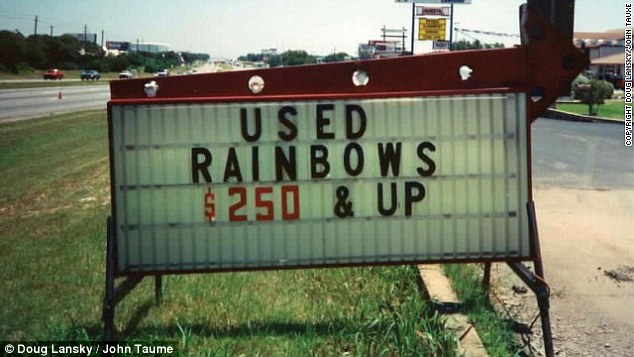
This sign in Rome, Georgia, has us asking: how much do new rainbows go for?

It’s clear from this Ambridge, Pennsylvania sign that Reverend John Ritter is one very content fellow
‘That is, new hilarious signs are going up all the time. At times, it seems like a race between the people who put up these ridiculous signs and those who try to photograph them.
‘Over the last 20 years, I’ve gathered well over 50,000 sign photos from well-travelled amateur and professional photographers.
‘Trying to decide which is unintentially funny enough to merit inclusion in a Signspotting book has been a challenge.
‘Trying to select favourites among those for this ‘ultimate collection’ has been downright unnerving.’

In Maui, Hawaii, the definition of the word ‘bottomless’ clearly means 65 feet

Slippery pedestrians are a problem when it rains, according to this grammar fail in San Francisco, California

A local dental clinic in Taipei, Taiwan sure doesn’t do much to assure nervous patients

In Dublin, Ireland, drivers are encouraged never to settle for second best

Ironically, the view of this New Hampshire sign is anything but clear

Commuters in Camebridge, Massachusetts, are warned of some major delays with this hilarious sign

Ears too floppy? Nose too long? According to this sign in Jaipur, India, there are people here to help
113 words for different things one could eat

These words generally end in “phagous“, from the Greek phagein, or “vorous“, from Latin vorare, both verbs meaning “to eat“. Which suffix you want to use depends on whether you feel like having souvlaki or spaghetti.
Word |
Definition |
| allotriophagy | craving for strange foods |
| androphagy | cannibalism |
| anthropophaginian | cannibal |
| anthropophagous | (again) eating humans |
| aphagia | inability to eat or swallow |
| apivorous | eating bees |
| arachnivorous | feeding on spiders |
| autocoprophagy | eating one’s own feces |
| autophagy | feeding on body’s own tissues |
| baccivorous | eating berries |
| batrachivorous | frog-eating |
| bibliophagist | one who devours books, literally or figuratively |
| calcivorous | feeding on or living in limestone |
| cardophagus | donkey; something that eats thistles |
| carnivorous | eating flesh |
| carpophagous | fruit-eating |
| cepivorous | onion-eating |
| chthonophagia | eating dirt |
| comburivorous | consuming by fire |
| coprophagous | eating feces |
| creatophagous | carnivorous; flesh-eating |
| creophagous | flesh-eating; carnivorous |
| detritivore | animal that eats decomposing organic matter |
| dysphagia | pathological difficulty in swallowing |
| endophagy | cannibalism within a tribe; eating away from within |
| entomophagous | eating insects |
| equivorous | consuming horseflesh |
| exophagy | cannibalism outside one’s own group |
| foliophagous | eating leaves; eating folios of books |
| formivorous | eating ants |
| fructivorous | feeding on fruit |
| frugivorous | eating fruit |
| fucivorous | eating seaweed |
| galactophagist | milk drinker |
| gamophagia | destruction of one gamete by another |
| geophagy | practice of feeding on soil; dirt-eating |
| glossophagine | eating using the tongue |
| graminivorous | feeding on grass or cereals |
| granivorous | feeding on seeds |
| gumnivorous | feeding on tree saps |
| herbivorous | eating only plant matter |
| hippophagy | feeding on horses |
| homnivorous | eating humans |
| hylophagous | eating wood |
| hyperphagia | eating too much |
| ichthyophagous | fish-eating |
| insectivorous | eating insects |
| kreatophagia | eating of raw meat |
| larvivorous | feeding on larvae |
| lignivorous | feeding on wood |
| limivorous | eating mud |
| lithophagous | stone-swallowing; rock-boring; eating rock |
| lotophagous | feeding on lotuses; indolent; lazy; dreamy |
| mallophagous | eating wool or fleece |
| meconophagist | consumer of opium or heroin |
| meliphagous | feeding upon honey |
| mellivorous | honey-eating |
| merdivorous | dung-eating |
| microphagous | feeding on small creatures or plants |
| monophagous | feeding on only one type of food |
| mucivorous | feeding on plant juices |
| mycophagous | eating fungus |
| myristicivorous | feeding upon nutmegs |
| myrmecophagous | feeding on ants |
| necrophagous | feeding on the dead |
| nectarivorous | feeding on nectar |
| nucivorous | nut-eating |
| omnivorous | eating anything; eating both plant and animal matter |
| omophagy | eating of raw flesh as a ritual observance |
| onychophagist | nail-biter |
| ophiophagous | eating snakes |
| oryzivorous | rice-eating |
| ossivorous | feeding on bones |
| ostreophagous | oyster-eating |
| ovivorous | eating eggs |
| ovivorous | eating sheep |
| paedophage | eater of children |
| pagophagia | eating trays of ice to help offset iron deficiency |
| panivorous | bread-eating |
| pantophagy | omnivorousness |
| phthirophagous | lice-eating |
| phyllophagous | leaf-eating |
| phytivorous | feeding on plants |
| phytophagous | feeding on vegetable matter |
| piscivorous | fish-eating |
| placentophagy | eating of the placenta |
| plantivorous | plant-eating |
| plasmophagous | consuming plasma |
| poephagous | eating grass or herbs; herbivorous |
| poltophagy | prolonged chewing of food |
| polyphagous | eating many types of food |
| psomophagy | swallowing food without thorough chewing |
| radicivorous | eating roots |
| ranivorous | eating frogs |
| rhizophagous | root-eating |
| rhypophagy | eating filth |
| sanguivorous | blood-drinking |
| saprophagous | feeding on decaying material |
| sarcophagous | feeding on flesh; carnivorous |
| saurophagous | eating lizards |
| scatophagous | dung-eating |
| seminivorous | seed-eating |
| stercovorous | feeding on dung or excrement |
| thalerophagous | feeding on fresh vegetable matter |
| theophagy | sacramental consumption of a god |
| toxicophagous | eating poison |
| toxiphagous | poison-eating |
| univorous | living on only one host or source of food |
| vegetivorous | eating vegetables |
| vermivorous | eating worms |
| xerophagy | eating of dry food; fast of dry food in the week preceding Easter |
| xylophagous | wood-eating |
| zoophagy | eating animals |
SOURCE
Image source


AWARDS









 Just English