Reality changes words…
…far more than the words can ever change reality.
A short lesson in political speaking
Quote of the day: venom

If snakes bites you, what’s the best thing to do?
Remain calm; separate the poison from the rest of your body and suck the poison out.
Worst thing to do: get upset, chase and kill the snake.Same when someone strikes at you verbally. Remain calm,; don’t try to strike back at the other person. Don’t let the poison spread throughout your system.
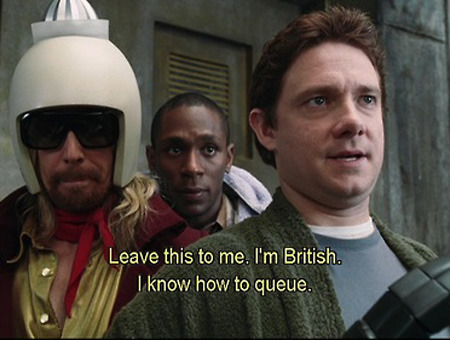
They said what?!
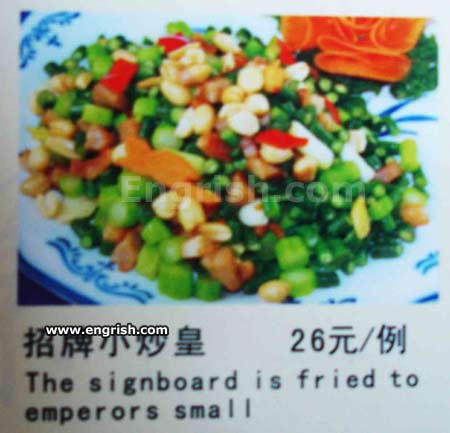
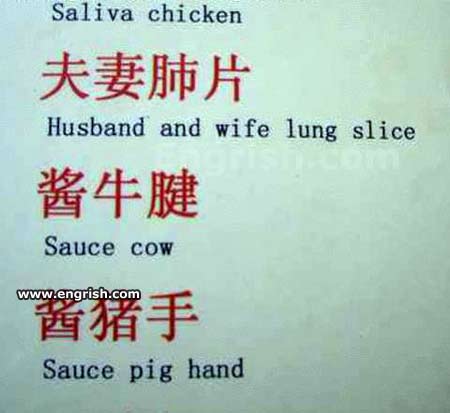
Engrish it is:
n. The phenomenon of often hilarious gramatical catastrophes resulting from poor, usually over-literal translations of Japanese to English.
A form of English characterized by bad translation from Japanese by someone who is decent at translating vocabulary but has a poor grasp of English grammar. Tends to be a word-by-word literal translation with humorous results for native English speakers. Engrish is most common in old video games and anime subtitles.
The term “Engrish” comes from the fact that the Japanese language does not have distinct L and R sounds. They do have a consonant that is roughly somewhere in between these two sounds, but whether this translates to L or R in English depends on the situation (and therefore can be interpreted wrong.)
So, there they go:











In mood for some more Engrish?
Must go now I to ,

Co-worker vs. colleague

What is the difference?
Co-workers are all of those people you work with. Some are on the same level as you, some higher, some lower. You all work at the same place though so you are co-workers.
Colleagues are those people that are your occupational peers (equal level of position and responsibility). Two high school teachers at the same school are coworkers and colleagues. The principal is also their coworker but not their colleague. The principals colleagues are other school principals.
The dictionary tells us that colleagues share class or profession whereas coworkers simply “works with another…”
Via Yahoo answers
A little bit but now you know it,
Idiom: He will give the Devil his due

Meaning
Literally, pay the devil what you owe him. Used figuratively to mean ‘give back what you owe’, either money or favours.
Origin
From Shakespeare’s Henry IV Part 1, 1597:
Constable: I will cap that proverb with ‘There is flattery in friendship.’
Orleans: And I will take up that with ‘Give the devil his due.’
I don’t believe in tests…

anymore.
A couple of days ago I posted an interesting online based vocabulary test and my result of 17.000.
Yesterday I got back to it and did the test once again (as you may have expected, I know the same set of words), BUT this time I checked different post-vocabulary fileds. Instead of “All of my subjects were in English” (or sth of the kind) I checked that I no more learn English and that I stopped about an year ago (true fact). On the additional questions (this time there were much more – I checked that I read, speak, and write a lot: with one word communicate a lot in English (the truth). Guess what, this time my result was not 17.000 but 23.500.
So, I decided to take another test and to see what would my n:
Found this one: http://dynamo.dictionary.com/placement/level
Result: 50.052
Pff, what should that mean?
For one it surely means that the tests are lost on me. The lot of them and all the pals, mates, and peers they might have.
I remembered how we once had that perfect candidate for the place of attorney in our office. He got 100/100 on each and every test but turned to be a weird psycho bloke post-hiring. He did know the matter but had no clue how to use it.
So, I’ll stop with tests and will continue with reading, speaking and writing a lot and…
come what may.
Your remaining-untested-in-the-future,
How many words do you know?

A nice tool that claims to access your English command (or, at least a rough estimate number of words that you may know):
Test your Vocab
- 1,500–3,000 words: a couple of years of English courses
- 4,000–7,000 words: intermediate English (4–6 years)
- 8,000–10,000 words: advanced English (8 years) for a particularly good student
Anything much beyond 10,000 words generally only comes from living abroad in an English-speaking country for a significant period of time, or else spending tremendous amounts of one’s own time exposed to English media (books, sitcoms, movies, etc.).
Mine are about 17.000 – 23.500*
*Did it once again, same words, different check ot the additional questions after the words.
Not bad for a non-native speaker, huh 😉
What is your result (no cheating, please 🙂 ) ?
Targeting 30 000,
10 British slang words, kindly translated for Americans

(B)
Barmy – If someone tells you that you’re barmy they mean you have gone mad or crazy. For example you’d have to be barmy to visit England without trying black pudding!
Bees Knees – This is the polite version of the dog’s bollocks. So if you are in polite company and want to say that something was fabulous, this phrase might come in handy.
Biggie – This is unusual. A biggie is what a child calls his poo! Hence the reason Wendy’s Hamburgers has never really taken off in England – who would buy “biggie fries”? Yuck – I’m sure you wouldn’t buy poo fries! The other meaning of Biggie is erection. It just gets worse!
Blimey – Another exclamation of surprise. My Dad used to say “Gawd Blimey” or “Gor Blimey” or even “Cor Blimey”. It is all a corruption of the oath God Blind Me.
Blinkered – Someone who is blinkered is narrow minded or narrow sighted – they only see one view on a subject. It comes from when horses that pulled carriages wore blinkers to stop them seeing to the side or behind them which stopped them from being startled and only let them see where they were going.
Bob’s your uncle – This is a well used phrase. It is added to the end of sentences a bit like and that’s it! For example if you are telling someone how to make that fabulous banoffee pie you just served them, you would tell them to boil the condensed milk for three hours, spread it onto a basic cheesecake base, slice bananas on top, add some whipped double cream, another layer of banana and Bob’s your uncle!
Box your ears – Many young chaps heard their dads threaten to box their ears when I was a littlun. Generally meant a slap around the head for misbehaving. Probably illegal these days!
Budge up – If you want to sit down and someone is taking up too much space, you’d ask them to budge up – move and make some space.
Bugger all – If something costs bugger all, it means that it costs nothing. Meaning it is cheap. If you have bugger all, it means you have nothing.
Butchers – To have a butchers at something is to have a look. This is a cockney rhyming slang word that has become common. The reason “butchers” means a look even though it doesn’t rhyme is because it is short for “butchers hook” and “hook” of course, does rhyme.
Your uncle,
Did you know? No, really, did you?
Bet you never stopped to think about it. 😉
- The most commonly used letter in the alphabet is E (1 out of every 8 letters written is an e).
- The least used letter in the alphabet is Q.
- Dreamt is the only word that ends in mt.
- The first letters of the months July through to November spell JASON. Read More…
Create music with words

This sentence has five words. Here are five more words. Five-word sentences are fine. But several together become monotonous. Listen to what is happening. The writing is getting boring. The sound of it drones. It’s like a stuck record. The ear demands some variety. Now listen.
I vary the sentence length, and I create music. Music. The writing sings. It has a pleasant rhythm, a lilt, a harmony. I use short sentences. And I use sentences of medium length. And sometimes, when I am certain the reader is rested, I will engage him with a sentence of considerable length, a sentence that burns with energy and builds with all the impetus of a crescendo, the roll of the drums, the crash of the cymbals–sounds that say listen to this, it is important.
Gary Provost, quoted in Roy Peter Clark’s Writing Tools
TBC…
Commencing my Monday with (more than) five words,


AWARDS









 Just English